 5th November 2026 (Updated on 5th November 2026)
Suffolk’s Village Signs: The Stories Hiding in Plain Sight
By Carl Scott
Here’s a challenge for your next Suffolk outing: find a village sign and actually look at it. Not just the name, which is useful if you’re lost, but the little pictures and figures above it. You might spot a saint, a ship, a horse or something that looks suspiciously like a medieval argument. Those signs are miniature history lessons, and they’re dotted all over the county. Better still, you don’t need a ticket, a guidebook or an enthusiastic man with a clipboard to enjoy them.
Village signs are especially associated with East Anglia, where communities have embraced the tradition of celebrating their identities through public artwork. Some feature churches or local buildings. Others depict wildlife, historic industries, legends or characters connected with the parish.
The pleasure lies in decoding the details. A ship might recall a settlement’s maritime past, while agricultural tools could represent generations of farming families. A crown, saint or heraldic symbol may hint at an important historical connection. Sometimes the meaning is obvious; sometimes it takes a little detective work.
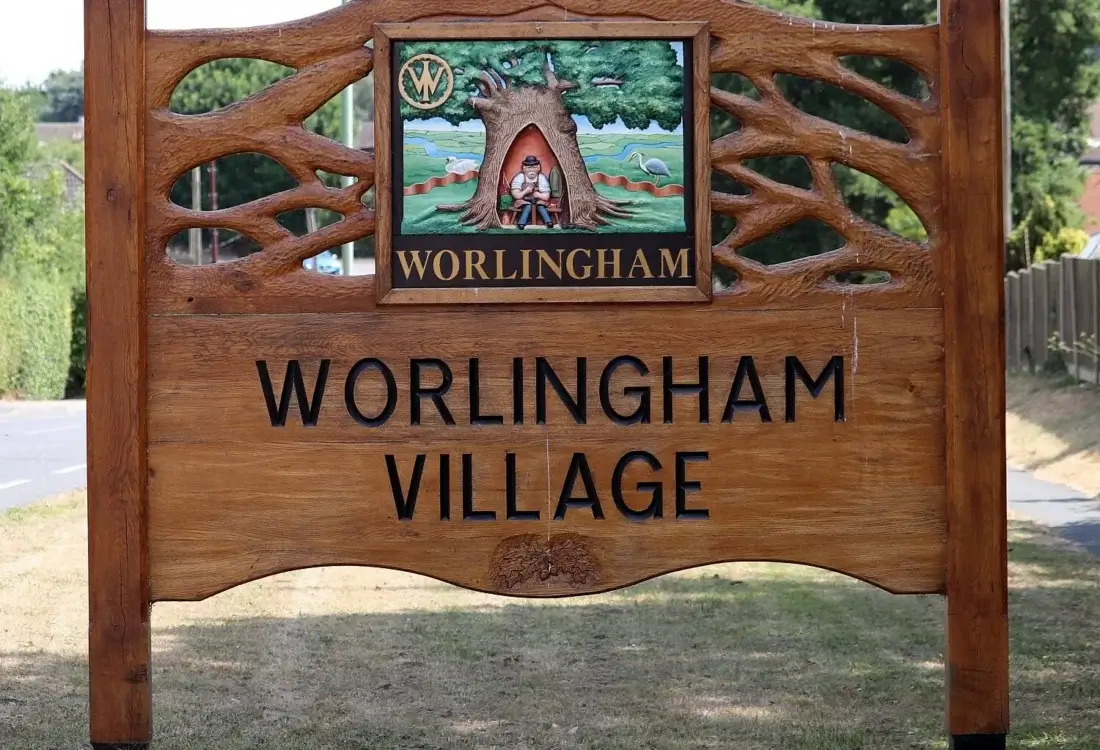
Consider Worlingham, whose village sign includes a cobbler working inside a hollow oak tree. The image refers to a local story about a craftsman who supposedly used an enormous tree as his workshop. The sign also celebrates a crinkle crankle wall and wildlife associated with the River Waveney. Several pieces of local identity are brought together in one small composition.
These signs are not necessarily ancient monuments.
I love that something as ordinary as a roadside sign can send you off investigating centuries of local history.
That distinction makes them particularly interesting. A sign tells us something about the past, but also about what a community chooses to remember. Why celebrate a particular trade, building or legend? Which stories become symbols, and which are left out? Public art offers a glimpse of local pride as well as local history.
Craftsmanship is another part of the appeal. Traditional sign makers combine painting, carving and metalwork to produce objects that can withstand years of British weather.
For families exploring Suffolk, village signs can turn an ordinary journey into a treasure hunt. Challenge children to identify animals, tools and buildings, then see whether the village church or information board provides further clues. It is a simple way to make history feel immediate.
They are also a reminder that heritage is not confined to castles and museums.
That is one of.
So the next time a colourful sign appears beside a Suffolk road, slow down and take a proper look when it is safe to do so. The artwork might reveal more about the village than its name alone ever could.
Next time you pass a Suffolk village sign, give it more than a glance. There’s a good chance the artwork is trying to tell you something about the place you’ve just entered. And if it sends you down a historical rabbit hole, all the better. That’s exactly the sort of detour I think makes exploring this county such a pleasure.
To begin exploring these villages and picking up some new linguistic tricks of your own during a holiday in Suffolk, be sure to take a look at the current availability of our Barns and Barges for rent.


 Dogs stay FREE